
What Is “Substance Attraction” and Why Is Everyone Talking About It
At some point in the last few years, a specific type of exhaustion became common enough to have a name. Swipe fatigue. App burnout. The creeping sense that you’ve been optimizing for first impressions so long that you’ve forgotten what you’re actually looking for. The culture diagnosed the symptom before it had a name for the cure.
The cure, as it turns out, has a name now too: substance attraction.
The concept is straightforward — attraction rooted in someone’s character, depth, and genuine passions rather than their filtered photos and opening-line charisma. Vice reported in 2026 that 71% of daters now describe themselves as attracted to “nerds” — and when they explain what that means, it comes down to the same cluster of traits every time: someone who knows things, cares deeply about them, and can be fully present with what they love. Someone with substance.
For gamers and geeks, this framing should feel familiar. Not because it’s flattering — though it is — but because it describes something the gamer community has always understood about itself: caring hard about something isn’t a liability. It’s a signal.
Why Shared Obsessions Are a Relationship Superpower
The costly signal theory, applied to gaming
In evolutionary psychology, a “costly signal” is a behavior that’s too expensive to fake — one that reliably conveys genuine information about the sender. Physical displays of strength are the classic example. But passion works the same way at a different level: 400 hours in a game you love isn’t something you do to impress someone. It’s something you do because you actually love it. That authenticity is legible to other people, even if they can’t articulate why.
When someone leads with a specific, deep interest — not “I like games” but “I’ve been running a Pathfinder campaign for three years and we just finished act two” — that specificity signals character. It tells you the person is capable of sustained investment, patience, and genuine enthusiasm. These traits don’t stay contained to the hobby.
The shared vocabulary effect
There’s a particular efficiency that shows up in conversations between people who share a reference frame. You can describe an entire emotional landscape through a single game moment — the feeling of finally clearing a boss you’ve been stuck on for days, the specific grief of a character death in a story you were invested in, the satisfaction of a well-coordinated team play — and have it land with complete precision to someone who’s been there.
This isn’t about exclusion or gatekeeping. It’s about communication density. Couples who share a cultural language communicate faster, more accurately, and with less translation overhead. That matters in the mundane moments, not just the big ones.
Hobbies that become dates by default
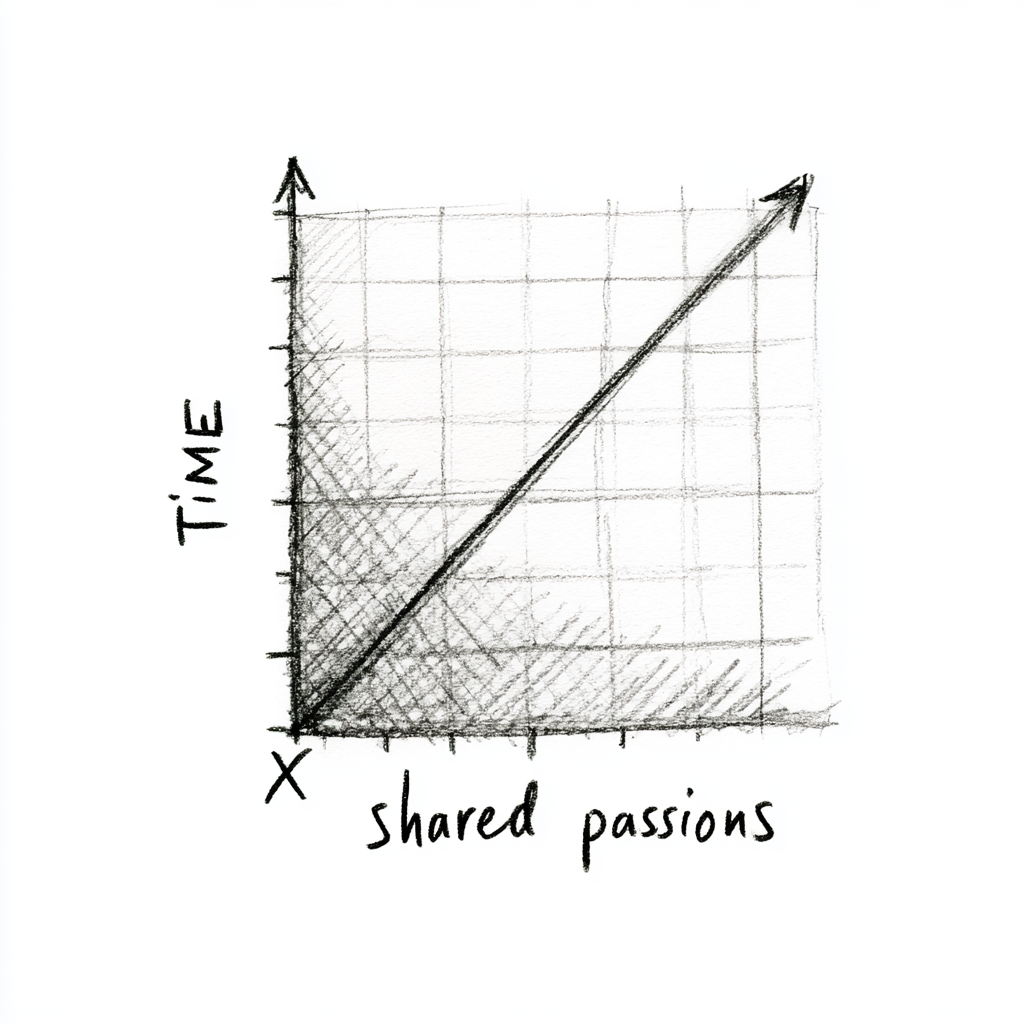
One underrated feature of shared gaming interests: the date calendar writes itself. Co-op sessions. Watching the new season of a show you’re both invested in. Going to a con together. Running a TTRPG campaign. These aren’t just activities to fill time — they’re experiences that are inherently shared, collaborative, and meaningful to both people. Partners without overlapping interests spend a lot of energy negotiating what to do. Partners with overlapping interests have the opposite problem.
What the Research Says About Compatibility and Shared Interests
The similarity-attraction effect
The relationship between similarity and attraction has been one of the most consistently replicated findings in social psychology since Donn Byrne’s foundational work in the 1970s. The basic result holds across decades of follow-up research: people are more attracted to, and form more satisfying relationships with, people who share their attitudes, values, and interests.
The mechanism isn’t mysterious. Shared interests validate your own sense of self — someone else caring about what you care about confirms that the thing you care about is worth caring about. That validation is inherently bonding. It’s also a predictor of what the relationship will actually feel like day to day, which is the thing early-stage attraction usually can’t tell you.
Why niche dating captures this advantage
Mainstream dating apps optimize for quantity of potential matches — which means the filtering for meaningful compatibility happens through conversation, usually slowly, usually after both people have already invested emotional energy. Niche platforms flip this: the most important filter (shared identity) is applied before the first match is ever made.
The WhichDating State of Online Dating 2026 report puts a number on this: niche dating platforms show 20–30% better compatibility outcomes than mainstream alternatives. That gap comes directly from the identity-first model. When everyone in the pool already shares your core premise, you’re not starting from zero.
The Gamer and Geek Advantage, Specifically
What gaming reveals about character
Gaming is one of the more honest personality tests available. The games someone gravitates toward and how they play them reveal a lot: their tolerance for frustration, their preference for collaboration or solo achievement, their relationship with failure and iteration, their interest in narrative versus competition versus strategy. You can tell a lot about a person by whether they restart every Baldur’s Gate 3 run before finishing a playthrough, or grind ranked ladder for 800 hours, or play Animal Crossing to decompress.
None of these are better or worse. But they’re specific, and specificity is compatible with finding someone whose gaming personality meshes with yours in the way that actually matters for a relationship.
Being “deeply unwell” about something as a green flag
The internet has developed a specific affectionate language for people with intense enthusiasms: “unhinged about this game,” “feral about this show,” “cannot be normal about this.” What these phrases actually describe is full investment — the willingness to care completely about something, to let it matter, to feel the highs and lows of it without ironic distance.
That capacity for full investment is one of the better predictors of what someone will bring to a relationship. People who can be completely present with something they love tend to bring that same quality to the people they love. The gamer who is genuinely, embarrassingly invested in a story or a character or a competitive result is displaying something worth noticing.
Where to Find This
The challenge with substance attraction — as with most things worth having — is that it requires the right environment. A mainstream dating app, optimized for swipe volume and visual first impressions, is structurally hostile to it. Depth doesn’t surface well in that format. Specific passions are homogenized into generic interest tags.
The environment that makes substance attraction findable is one where identity comes first. Where the shared premise is established before the first conversation, not built toward it through dozens of carefully managed exchanges. That’s what a gamer dating platform is designed to do — and why it produces different outcomes than a general-purpose app ever will.
If you’re a gamer or geek who’s been selling yourself short on platforms that weren’t built for you: download the LFGdating app free — everyone there already cleared the first hurdle before you arrived.
Leave a Reply
You must be logged in to post a comment.