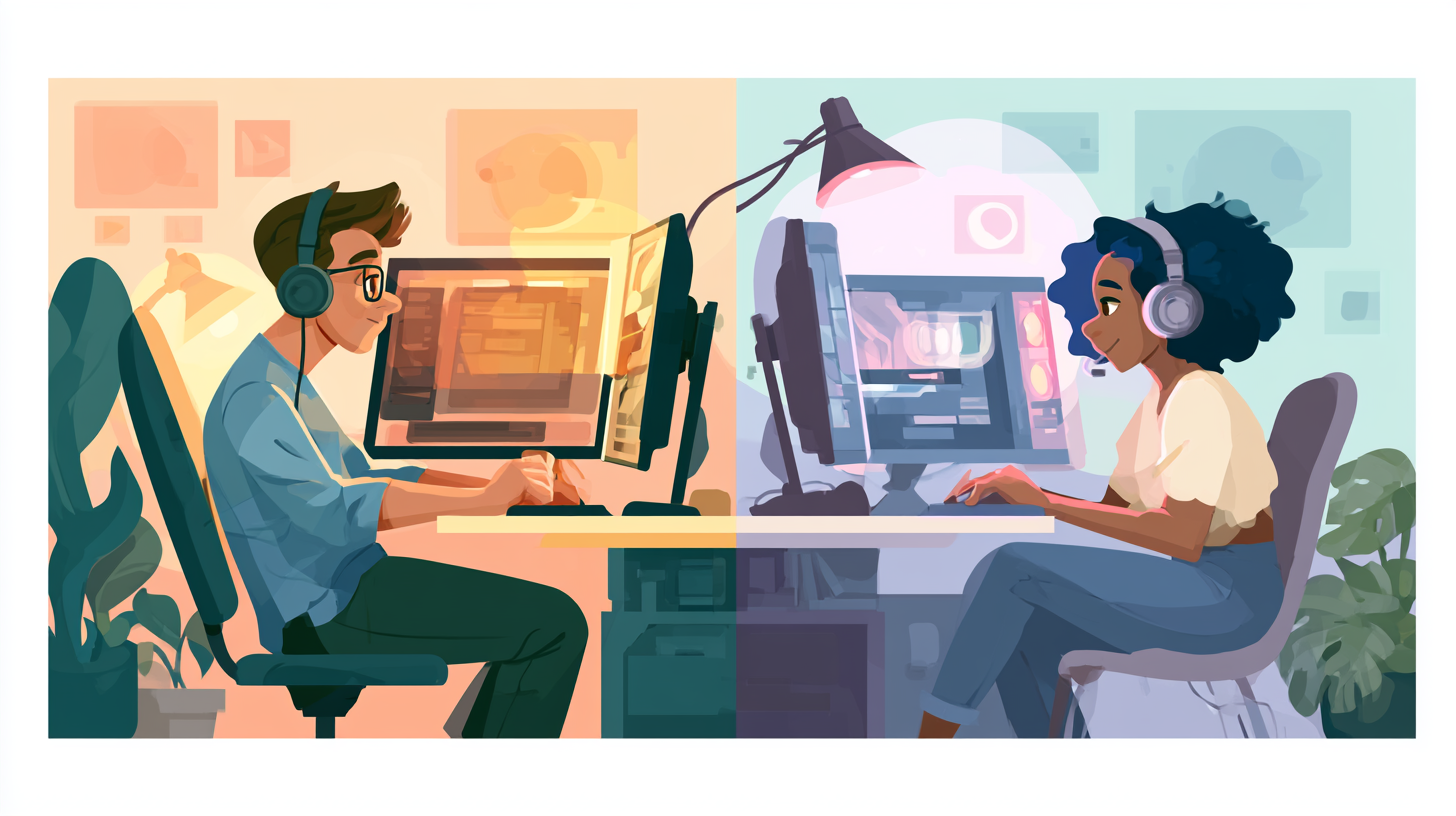
You’ve been queuing with the same person for three weeks. You know their playstyle better than your own. The sessions run two hours longer than anyone planned, the voice comms have drifted from callouts to actual conversation, and somewhere in there you caught yourself hoping they’d be online tonight. So you do the thing every gamer does eventually: you open a search bar and type some version of can you actually fall in love with someone you met gaming?
Short answer: yes. Longer answer, with receipts: also yes — and it’s far more common than the culture gives it credit for. This is the complete guide to how online gaming relationships actually form, what the research says about whether they last, and how to take one from a shared lobby to something real.
The Way Gamers Actually Meet (And Why It Works)
Nobody plans it. You’re not “putting yourself out there.” You’re just trying to clear the raid, hold the point, or finish the co-op campaign your friend bailed on. Then a stranger turns out to be funny under pressure, generous with the loot, and weirdly easy to talk to during downtime — and the dynamic shifts before either of you names it.
This is one of the most common origin stories in gaming, and it’s not an accident. Games are unusually good at creating the exact conditions psychologists associate with attraction: repeated contact, shared goals, and high-information situations where you see how a person really behaves. A dating profile gives you a curated highlight reel. A ranked queue at 1 a.m. gives you the director’s cut.
What Online Gaming Relationships Have That Dating Apps Don’t
You see the real person before the polished profile
Dating apps run on presentation. You get the best six photos, a bio workshopped with friends, and a conversation where both people are auditioning. Gaming runs on behavior. You find out how someone handles losing, whether they tilt and blame the team or reset and refocus, how they treat the randoms who are clearly having a bad night, and whether they actually call shots or just complain about them. None of that is performable over forty hours of playtime. The mask comes off because the game demands your attention more than your image management does.
Trust builds through co-op stakes
“What do you do for work” is small talk. Holding a corner together while everything goes sideways is a bond. Collaborative pressure — a shared objective, real interdependence, the small wins and losses you rack up session after session — builds emotional investment faster than the standard getting-to-know-you script. You learn to rely on someone, and being relied on feels good. That’s not a gaming quirk; that’s how humans bond, and games happen to manufacture it on tap.
Repeated contact is the underrated driver of attraction
One of the most reliable findings in social psychology is the mere-exposure effect: the more we’re around someone, the more we tend to like them. Most adult life makes repeated, low-pressure contact with new people genuinely hard to come by. Gaming hands it to you for free. Session after session, week after week, you’re logging hours with the same person in a relaxed setting where the activity carries the conversation. That’s the slow-build dynamic rom-coms keep trying to engineer — and your friends list does it without trying.
What the Research Actually Shows
This isn’t just vibes. In 2026, researchers published a peer-reviewed study — “Partnership through Play,” a mixed-methods look at how long-distance couples use digital games to build and maintain intimacy — and found that playing together functioned as a genuine relational tool, not a distraction from the relationship. For couples separated by distance, gaming recreated the everyday “just hanging out” texture that closeness normally depends on.
The broader numbers back up how mainstream online connection has become. According to SSRS’s 2026 report on the public and online dating, 37% of U.S. adults have used an online dating site or app at some point, and half of those people (50%) say they’ve been in a committed relationship with someone they met that way. Even on the skeptic question, the public has come around: 58% of adults now believe relationships that start online are just as successful as those that start in person.
Gaming sits squarely inside that shift. In a survey by PubNub, a gaming communications company, 43% of gamers said they’d found friendship or love through in-game chat, and 40% said they’d met more people through gaming than in person. (It’s a company-commissioned survey, so take the precise figure with the usual grain of salt — but the direction is the same story everyone in the community already knows.) Put it together and the conclusion is hard to dodge: relationships that start through gaming aren’t rare, weird, or lesser. They’re a normal way people meet now.
Online Gaming Relationship to Real Life: The Actual Path
The natural escalation pattern
Gaming relationships tend to climb a predictable ladder: in-game chat, then voice comms, then personal socials, then a video call, then meeting in person. Each rung is a low-stakes signal test. You suggest the next step; they either lean in or they don’t. Most connections that fizzle don’t die because the spark wasn’t real — they die because nobody initiated the next rung. The single biggest skill here isn’t charisma. It’s being willing to make the small, slightly scary move before the moment passes.
What “long-distance gaming relationship” actually means
The gamer community has always been geographically scattered, which means a huge share of these connections start as long-distance by default. That sounds like a disadvantage until you look at how the medium works: the same game you met in becomes the shared ritual that holds the relationship together across time zones. We dig into exactly why that works — and what the strongest long-distance gaming couples do differently — in this week’s deep dive on long-distance gaming relationships.
When to bring in a dedicated platform
Sometimes the organic route stalls. One of you is shy, the timing never lines up, or the game winds down and takes the momentum with it. That’s exactly the gap a gamer dating site fills. On a platform like LFGdating, where everyone has already stated that they’re looking, the entire “wait, are they into me or just being a good teammate” problem disappears. You’re not decoding signals anymore; intent is on the table from the first message. You can download the LFGdating app free on iOS and Android and skip straight to the part where both people already know why they’re there.
The Mistakes That Tank Gaming Relationships Before They Start
A few patterns show up over and over, and all of them are avoidable:
- Going from zero to intense. Late-night voice chats are intoxicating, and it’s easy to mistake “we talked until 4 a.m.” for “we’ve built something real.” Let the connection accumulate evidence before you hand it your whole heart.
- Staying in-game-only forever. The comfort of the lobby is real, and so is the trap. If it never moves to voice, video, and eventually the open conversation, it stays a very nice friendship with a question mark over it.
- Confusing game-them with real-them. Good in-game tends to track with good in life — but “tends to” isn’t “guarantees.” Verify the person, don’t just trust the avatar.
- Doing it all on hard mode. If reading subtext for three weeks sounds exhausting, you’re allowed to skip it. That’s the entire point of a platform built for this.
Frequently Asked Questions
Can you really fall in love with someone you met online gaming?
Yes — and it’s more common than most people assume. Gaming creates unusually strong conditions for attraction: repeated contact over time, shared stakes, and situations that reveal real personality. The 2026 peer-reviewed study “Partnership through Play” found that couples used gaming specifically to build and maintain emotional intimacy, even across distance.
How common are relationships that start through gaming?
More common than mainstream coverage suggests. SSRS’s 2026 data shows 37% of U.S. adults have used a dating site or app, and half of them have had a committed relationship with someone they met online. Gaming is increasingly one of the specific channels inside that broader trend — a PubNub survey found 43% of gamers reported finding friendship or love through in-game chat.
What’s the biggest difference between meeting through gaming versus a dating app?
Intent and information. A dating-app match comes with declared interest but almost no real data about the person. A gaming connection is the reverse: you’ve got hours of behavioral evidence — how they handle pressure, how they treat teammates, whether they’re actually funny — before anyone says anything romantic. The ideal, honestly, is both: the rich signal of gaming plus the clear intent of a platform built for dating.
How do you turn a gaming friendship into something more?
Escalate the medium, not just the conversation. Move from in-game chat to voice, voice to personal socials, then to a video call, then to meeting up if geography allows. Each step is a small test of mutual interest. If they keep saying yes, you have your answer. Our full practical guide to making that move walks through it step by step.
Is a gamer dating site better than meeting someone organically through games?
They solve different problems. Organic connections give you personality data before any romantic framing exists — that’s genuinely valuable. A gamer dating site like LFGdating gives you a pool of people who are explicitly looking, which erases the ambiguity problem entirely. For most gamers the best approach is both: play games, be a person, let connections happen — and create a free LFGdating profile for when you’d rather be deliberate about it.
Leave a Reply
You must be logged in to post a comment.