
I’ve Been the Nerd on the Wrong Platform
There’s a specific calculation that happens when you’re setting up a dating profile on a mainstream app. You open the bio field and you start making decisions: how much do I mention gaming? If I say I play games, does that end the conversation before it starts? If I don’t mention it, am I setting up a situation where I have to explain myself later anyway?
You’re not making these decisions because you’re embarrassed about gaming. You’re making them because you’ve done enough of this to understand the risk. You’ve had the conversations where someone asks what you do for fun and you say “I game a lot, mostly RPGs” and you watch their face go somewhere distant. You’ve matched with people who thought “gamer” meant something it didn’t — and you’ve had to spend the first three messages doing image management instead of actually talking.
This is exhausting in a way that’s hard to explain to someone who hasn’t experienced it. It’s not just being rejected. It’s the recurring cost of presenting yourself as a managed, legible version of who you are, over and over, on the chance that this particular person is the one who’ll get it.
Patrick and I both lived this. And it’s the reason LFGdating exists.
The Phone Call
It was a Tuesday night, sometime around 2010. Patrick called from Hawaii — he was stationed there, Marine officer, not exactly drowning in opportunities to meet people in the way you might imagine. He had a question:
“You said you could make a dating site for gamers, right?”
— Patrick, from Hawaii, on a phone call I will never forget
I said yes. He said we were doing it. And that was approximately the whole business plan for the first few months.
What we were building was not, in the beginning, a company. It was a solution to a problem we’d both had. “LFGdating organically sprouted from our want to provide others with something neither of us had back then: a clean, tasteful dating site for mature gamers.” That’s the honest version. We were the target user. We built it for ourselves and hoped other people would feel the same way.
While Patrick was still in Hawaii and I was in Georgia — roughly 4,200 miles between us — we coordinated across time zones, scheduled calls around our respective jobs, and kept building. For me that meant teaching full-time, then coming home and working on LFGdating until midnight most nights. I turned down two coaching opportunities during that stretch, including a varsity head coaching job, because I had other work to do. That’s not a complaint. That’s just what it takes to build something real.
What Thirteen Years Has Taught Us About Gamer Love
The thing I didn’t expect when we started was how much I’d learn from the community that came together on LFGdating. Not in a data way — in a human way.
We’ve heard from people who met on LFGdating and got married. People who were so burned out on mainstream dating that they almost stopped trying, and then found someone through the site and couldn’t believe how different the experience was. People who describe the difference as: on every other platform, I was an edge case. Here, I’m the baseline.
We’ve also heard from people who didn’t find a relationship but found a community. People who came looking for a date and found a place that just felt like them. That counts.
The metric I care about most, and have always cared about most: cancel subscription notices from paying subscribers who are leaving because they met someone.
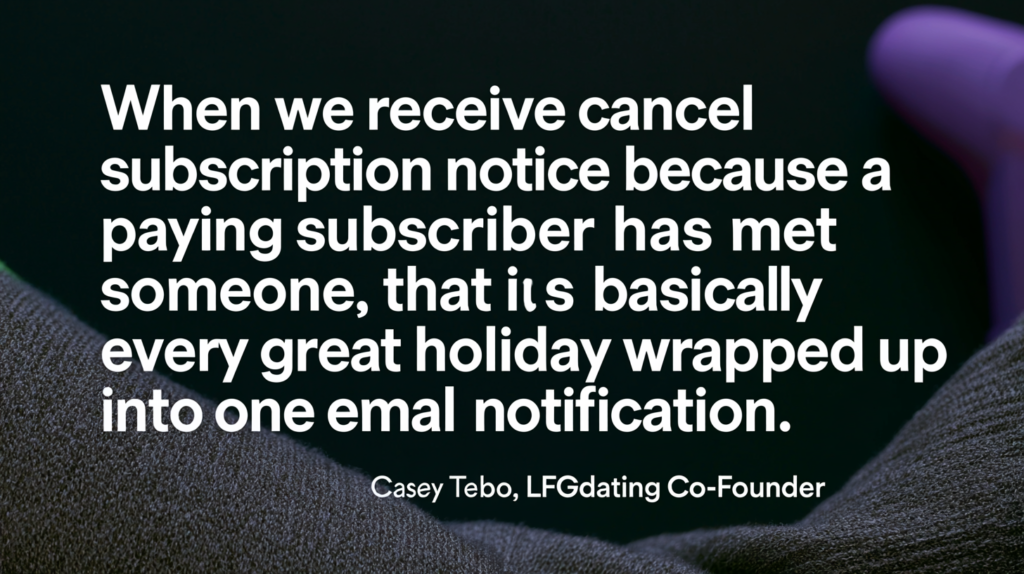
“When we receive a cancel subscription notice because a paying subscriber has met someone, that’s basically every great holiday wrapped up into one email notification.”
I still feel this every time it happens. It’s an unusual thing to celebrate churn, but that’s our actual business model: succeeding ourselves out of a customer’s life in the best possible way.
Geek Identity Isn’t a Filter — It’s the Entire Foundation
The reason LFGdating works — to whatever extent it works — is not that we added a gaming interest tag to a generic dating platform. It’s that the entire design premise is different: every person who signs up is someone who self-identified as a gamer or geek before they ever saw another profile. The shared foundation exists before the first match.
What that means in practice is that none of the conversations I described at the top of this post need to happen. You’re not deciding how much gaming to mention. You’re not managing the risk of a face going somewhere distant. You start from the assumption that the person on the other end of the match is someone who already gets it — because they’re here for the same reason you are.
“There is a large difference between sticking out as a gamer and standing out for your passion.”
That’s the whole thing. Standing out for your passion requires an environment where passion is the standard — not the exception to manage.
We built that environment. We’re still building it. And we’re still, 13 years in, running it without hiding behind a corporate banner. My personal email is available to members. So is Patrick’s. We’ve both stepped away from personal situations to respond to member questions, because that’s what we signed up for. That’s not a marketing claim — it’s just how this has worked from the beginning.
What I’d Tell Every Nerd Who’s Burned Out on Mainstream Apps
The calculation I described at the top of this post — the one where you decide how much gaming to mention — you don’t have to do that anymore. Not here.
LFGdating was built specifically for the person who is tired of managing their identity on platforms that weren’t designed for them. The community has been here since 2012. The profiles are real (we check them, by hand). The founders are reachable. The model is built to work for you, not for people who find you an interesting edge case.
If you’ve been waiting for a sign that it’s worth trying: this is it. Start for free. Two minutes to set up. The people who already speak your language are on the other side.
Stay Classy,
Casey and Pat
Leave a Reply
You must be logged in to post a comment.